


Today, low back, neck, and shoulder pain are among the most common musculoskeletal complaints. In particular, for desk-based workers, a large proportion of these symptoms are associated with prolonged sitting and a sedentary lifestyle. Although the source of these problems is often attributed to muscles or joints, current scientific evidence suggests that fascial dysfunction may be an important underlying mechanism contributing to persistent pain patterns.
Fascia is a dynamic connective tissue network that envelops the body from head to toe and links all structures together. A healthy fascial system is supported by adequate movement, fluid balance, and varied loading. However, a sedentary lifestyle may negatively affect the structural and functional properties of fascia over time—potentially leading to stiffness, reduced tissue glide, and pain sensitivity.
If you wake up feeling stiff, struggle to move after sitting for long periods, and notice that your pain “improves once you start moving,” this pattern may not be explained by muscle fatigue alone. It can also be interpreted through the lens of the fascia–pain relationship. In this article, we discuss what fascial dysfunction is, how sedentary behavior can influence fascia, and how this process may relate to chronic pain—based on available scientific knowledge.
What Is Fascia? (Focus Keyword: What is fascia?)
Fascia is a continuous connective tissue network that surrounds muscles, bones, nerves, and organs—integrating them into a whole-body system.
Healthy fascia typically:
- Contains a high proportion of water
- Allows tissue layers to glide smoothly
- Behaves elastically during movement
However, reduced movement can negatively influence these biological properties.
How Does a Sedentary Lifestyle Affect Fascia?
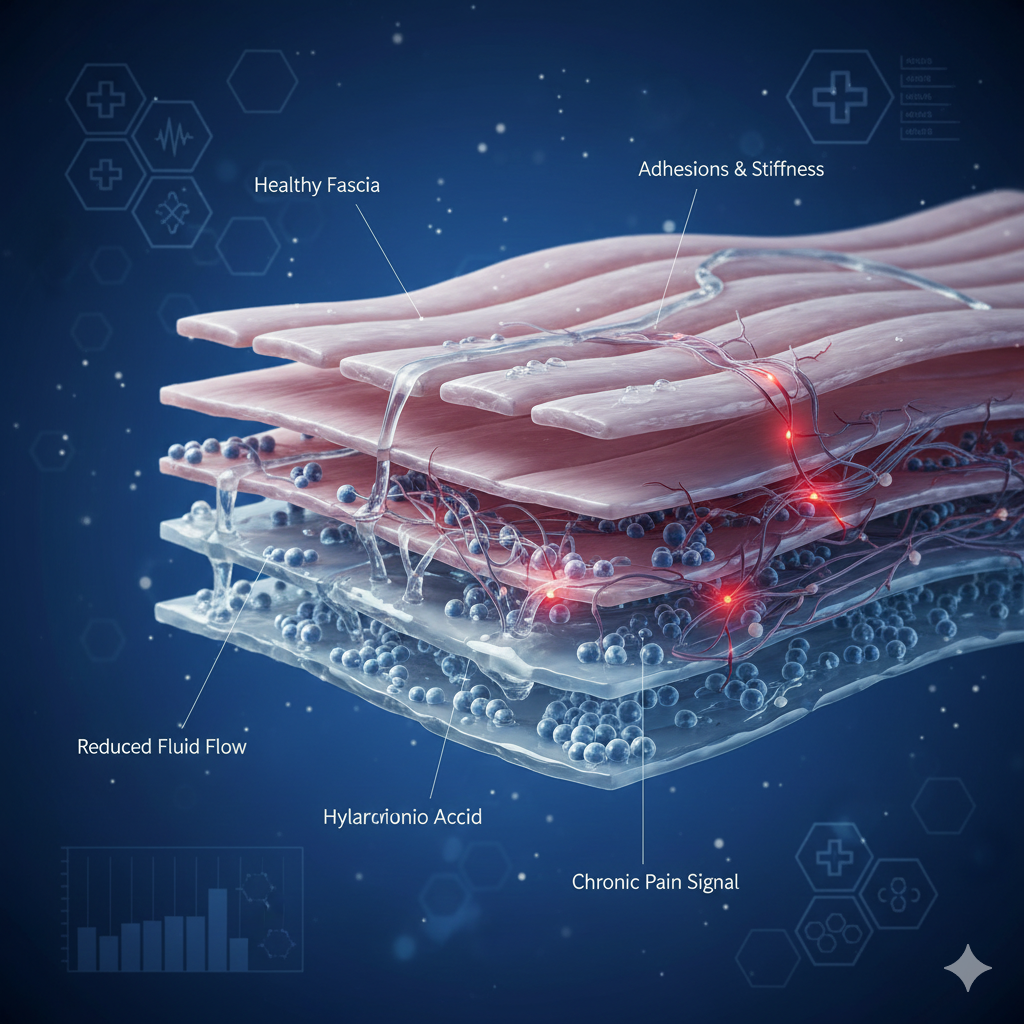
Prolonged sitting and staying in the same position for extended periods may:
- Reduce interstitial fluid flow between fascial layers
- Increase the concentration/thickening of hyaluronic acid within the tissue interface
- Contribute to reduced sliding and the development of adhesions between tissue layers
As a result, fascia may gradually lose its elastic, well-lubricated behavior and become stiffer and more pain-sensitive. In the literature, this pattern is often discussed under the concept of fascial dysfunction.
“The Body Learns the Shape It Sits In”: Fascial Adaptation
As described by Leon Chaitow, a core mechanism related to fascial dysfunction can be summarized as:
Low load – long duration – structural adaptation
During hours spent at a desk, fascia adapts to the same posture repeatedly. Over time, this posture may:
- Become perceived as “normal” by the body
- Contribute to persistent postural changes
- Lead to movement restriction and pain
This may help explain why some people continue to experience chronic low back pain, neck pain, or shoulder pain even when imaging results appear normal.
Common Fascial Issues in Sedentary Individuals
Neck and Shoulder Region
Upper Crossed Syndrome
- Shortening/tightness in the anterior chest fascia
- Excessive tension around the scapular region
- Neck and shoulder pain patterns
Low Back and Hip Region
- Fascial stiffness around the hip flexors
- Changes in pelvic tilt mechanics
- Chronic low back pain
Over time, fascial restrictions in these regions may influence whole-body mechanics.
Fascia Is Not Only a Mechanical Tissue
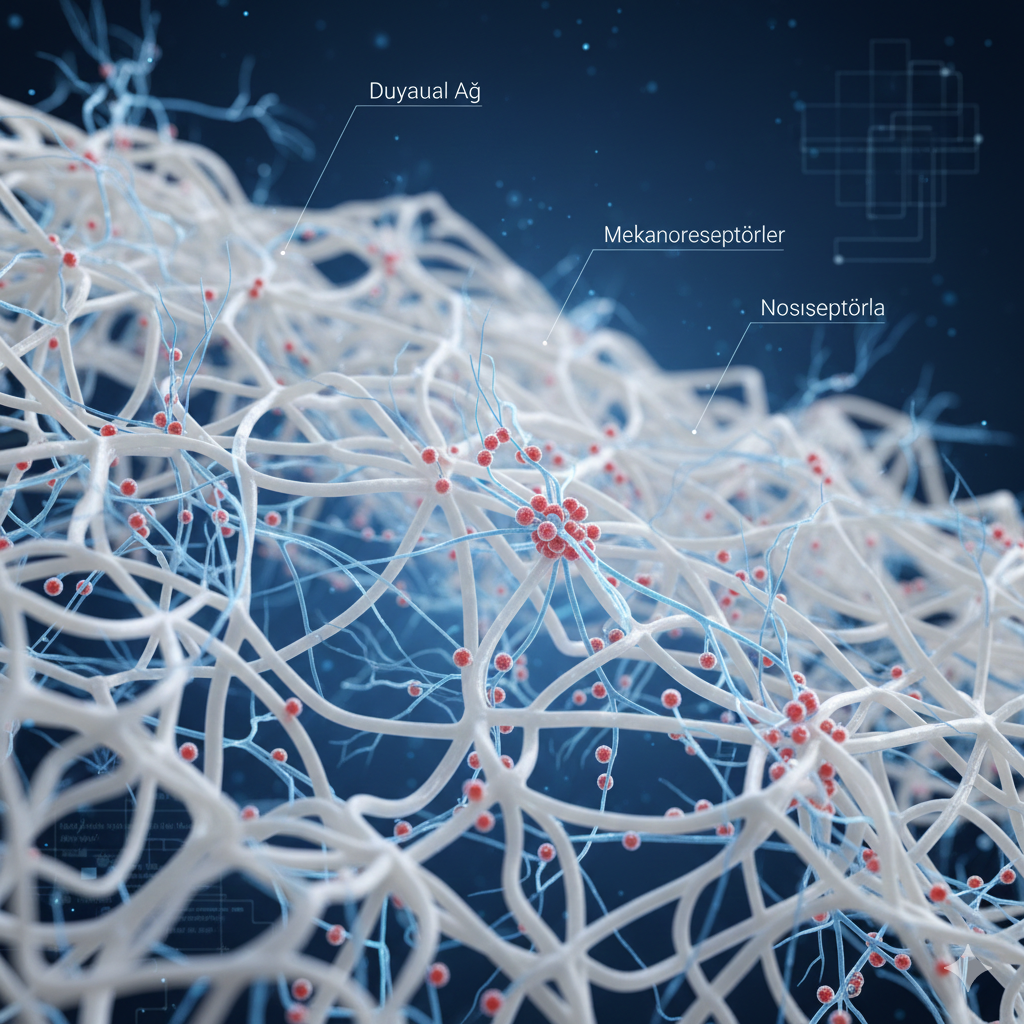
Current research indicates that fascia is not merely a structural connective tissue; it may also function as a sensory tissue with a high density of nerve endings.
Within fascia, there are:
- Mechanoreceptors
- Nociceptors (pain-related receptors)
- Connections to the autonomic nervous system
Therefore, some pain presentations may be driven not only by muscles but also by fascial mechanisms.
Why Are Slow and Sustained Techniques Often More Effective?
Fascia is a viscoelastic tissue. This means it tends to resist sudden, high-force inputs, yet it can respond to sustained loads applied over time.
The 60–90 Second Rule (Myofascial Induction)
According to clinical myofascial induction approaches:
- Reaching the first restrictive barrier in fascia may require at least 60–90 seconds of sustained, steady pressure
- Stopping before this window may keep the intervention superficial
- Meaningful tissue “release” is often described after this threshold
That’s why foam roller or massage ball work is generally more effective when performed with patience, control, and steady breathing.
Why Can Excessive Pressure Be Counterproductive?
When pressure is:
- Too intense
- And pain intensity rises above ~7/10
the tissue may trigger protective responses (guarding), which can reduce relaxation and limit the intended benefit.
Fascia Works as a “Tensegrity” System
The fascial system follows tensegrity principles. In practice, this means:
- A restriction in one region
- May contribute to symptoms in another region
For example:
- Hip fascial stiffness → low back pain patterns
- Neck fascial restriction → head or jaw-related complaints in some individuals
For this reason, fascial assessment and management generally benefit from a whole-body perspective.
Evidence-Informed Tips to Keep Fascia Healthy
- Hydration: fascia contains a high proportion of water
- Varied movement: not only walking—include rotation, side-bending, and reaching movements
- Slow release strategies: avoid sudden, aggressive techniques
These habits may help reduce the impact of sedentary living on fascial function.
Conclusion
A sedentary lifestyle may affect the fascial system even before muscles begin to feel the full impact of reduced movement.
Fascial dysfunction may be a meaningful contributor to:
- Chronic low back pain
- Neck and shoulder pain
- Movement restriction
Understanding fascia encourages a whole-system view of pain—rather than focusing only on the area that hurts.
Do You Feel Stiff After Long Hours of Sitting?
Persistent stiffness, neck pain, shoulder discomfort or low back pain may not be explained by muscles alone. Fascial stiffness, movement habits and sedentary lifestyle patterns should be assessed together.
At Ulus Physiotherapy in Besiktas Akatlar, our physiotherapy team provides movement analysis, myofascial assessment, manual therapy and individualized exercise planning.
Contact via WhatsAppScientific Basis & References
This content was prepared based on the following key resources:
- Myofascial Induction Therapy (MIT®) – clinical protocols
- Chaitow L. Fascial Dysfunction: Manual Therapy Approaches
- Schleip R, Wilke J. Fascia in Sport and Movement




Bir yanıt yazın